
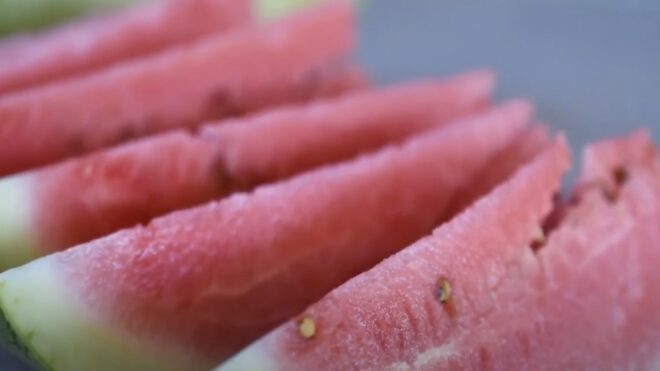
Due to its geographical location at the southernmost tip of Taiwan, the red-fleshed watermelons grown near the stream in the Sihchongxi Hot Spring area of Checheng Township, Pingtung County, are the only winter melons available in Taiwan. This month marks the beginning of the harvest season. Last year, the strong winds of Typhoon Koinu severely impacted the seeding period, not only delaying the harvest season but also reducing the cultivation area and yield by thirty percent.

Consequently, this year’s watermelon festival, themed “Enjoying Sweet Melons after a Beautifying Hot Spring Bath,” had to be canceled. Despite selling for a high price of 22 NT dollars per Taiwanese jin, farmers lament that this price increase cannot compensate for the loss in production.
In Taiwanese measurement, one "jin" (斤) is equivalent to 600 grams.
Lin Maosheng 林茂盛, the general secretary of the Checheng Area Agricultural Association, says that the red-fleshed watermelons grown along Sihchongxi and Damei Streams are harvested in winter, defying the common perception of watermelons as a summer fruit. With a cultivation area of about 20 hectares, the limited yield is exclusively available in winter. Most of the produce is pre-ordered before hitting the market, with some sold at the agricultural association’s supermarket in Checheng and others at roadside stalls. The winter Sihchongxi Hot Spring tourism season, which draws tourists, often leads to questions about whether the melons are imported from Southeast Asia, but they are actually authentic Taiwanese produce.

He explains that the Sihchongxi red-fleshed watermelons are planted in September each year, with a growth period of about three months. Irrigated by water from the upstream Mudan Reservoir and Damei Stream, and enriched by the mineral-rich soil, these watermelons, though smaller in size at around 20 Taiwanese jin (around 12 kg), are known for their sweetness and crispness.
This year, the planting period was severely affected by Typhoon Koinu in early October, resulting in reduced area and delayed harvest, leading to the cancellation of the annual promotional watermelon festival. Farmers regret that even though they broke the usual price of under 20 NT dollars per Taiwanese jin, they still cannot make up for the loss in production.

“Enjoying sweet watermelon after a beautifying hot spring bath is perfect for this season!” says Chen Zhengxiong 陳政雄, the mayor of Checheng Township. The Sihchongxi watermelons, grown in the harsh environment of the ‘downslope wind,’ are a source of pride for the farmers.
The Sihchongxi Hot Spring season attracts tourists to the hot spring park for its romantic lantern-lit nightscapes and hot springs, with enjoying sweet melons post-bath becoming a unique local feature.
The Pingtung County Agriculture Department notes that Pingtung is the original home of watermelons, not only producing over 70% of the country’s watermelon seedlings but also seeing farmers plant them all over the island like nomads. Following the Sihchongxi winter watermelon season, the harvesting season moves north to the Fangshan Stream area on the Hengchun Peninsula, and then to Hualien.
Local farmers but also a symbol of the unique agricultural practices in Taiwan, particularly in the southern part of the island. Their cultivation and the resulting product stand as an example of how local conditions and traditional knowledge can combine to create a unique and valuable agricultural product.