
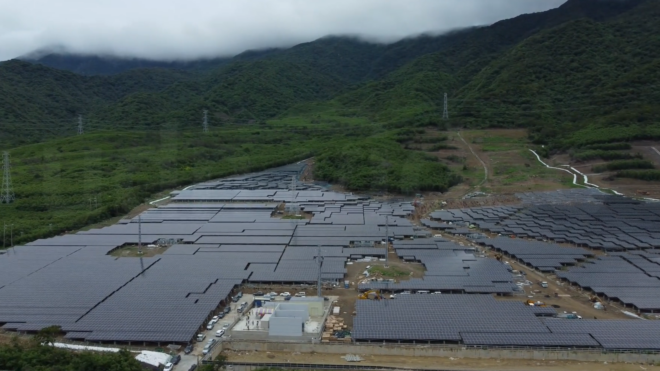
Solar panels in Pingtung are overtaking large swaths of farmland and forests, including the Stone Camp, a military relic left by the Japanese army during World War II. Despite ongoing public protests, the transformation of the landscape from green to grey continues. Local youths, lamenting the changes to their homeland, speculate that if Chi Po-lin, the director of the documentary “Beyond Beauty: Taiwan from Above,” were still alive to shoot a sequel, he would likely shake his head in dismay at the sight of this ‘solar-powered Taiwan’.
At the boundary of Shizi Township and Checheng Township, on the Ping-E Highway leading to Kenting, a 32.5-hectare hillside area has been transformed from lush greenery into a solar energy farm by Sande Energy Company 三地能源公司, with ongoing expansion. Netizens have shared photos of the solar farm, with many expressing dismay at the deforestation for energy production, questioning if this is a new concept of ‘managing mountains’. The Pingtung County Government states that this project is centrally reviewed and entirely legal.
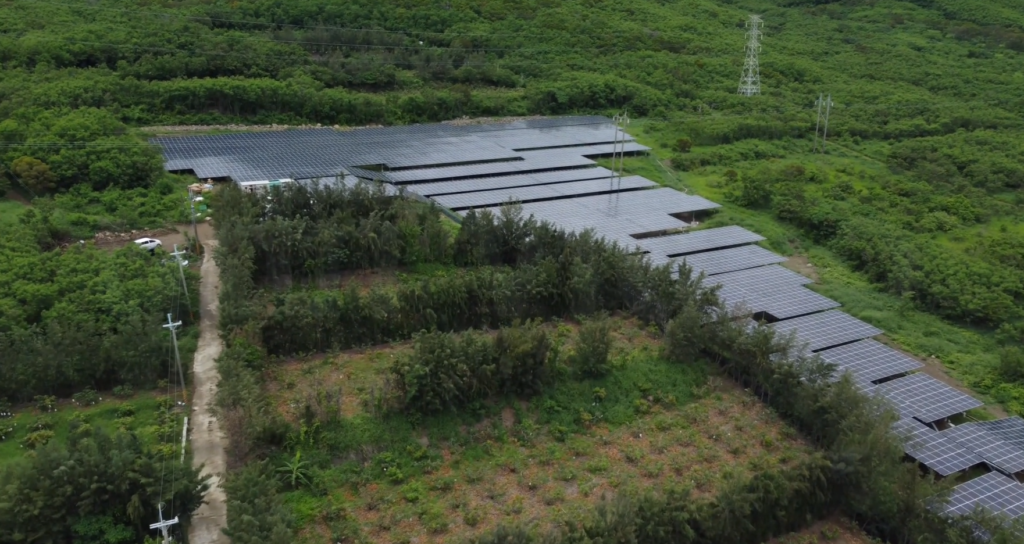
The Checheng Township head, Chen Zhengxiong, points out that the massive solar farm has drastically altered the landscape and impacted both the environment and the lives of local residents, with the company failing to communicate beforehand.
Villagers nearby complain about the endless dust in their homes due to the “downslope wind” in autumn and winter and worry about potential landslides triggered by heavy rain. Sande Energy has responded by strengthening soil and water conservation measures and sprinkling water to reduce dust, as well as establishing a double-layer green belt along the provincial road.
Below a two-hectare solar farm in Fenglin Village, Shizi Township, less than fifty meters away lies an indigenous tribe. Following a landslide triggered by Typhoon Koinu in October last year, the tribe members grew worried about becoming “the second Xiaolin Village” and decided to ask the developers to halt the project, also requesting the county government to revoke the application.
“The right things shouldn’t be placed in the wrong locations,” says Qin Xiaozhang, the head of the Fenglin Village Self-Rescue Association. He acknowledges the benefits of green energy but points out the problems with site selection and lack of proper communication with the local community.
The solar farm has also encroached upon the World War II military fortress “Stone Camp” in Xin Kai Village, Fangliao Township. The Japanese army constructed multiple bunkers there, with a complex network of tunnels underneath. The solar farm, operated by AU Optronics’ subsidiary Lextar Energy, leased the land for a three-phase solar project. Local civic groups formed the “Defend Stone Camp Alliance” in response to the development. The first phase of the project is already completed, but the second and third phases are currently on hold.
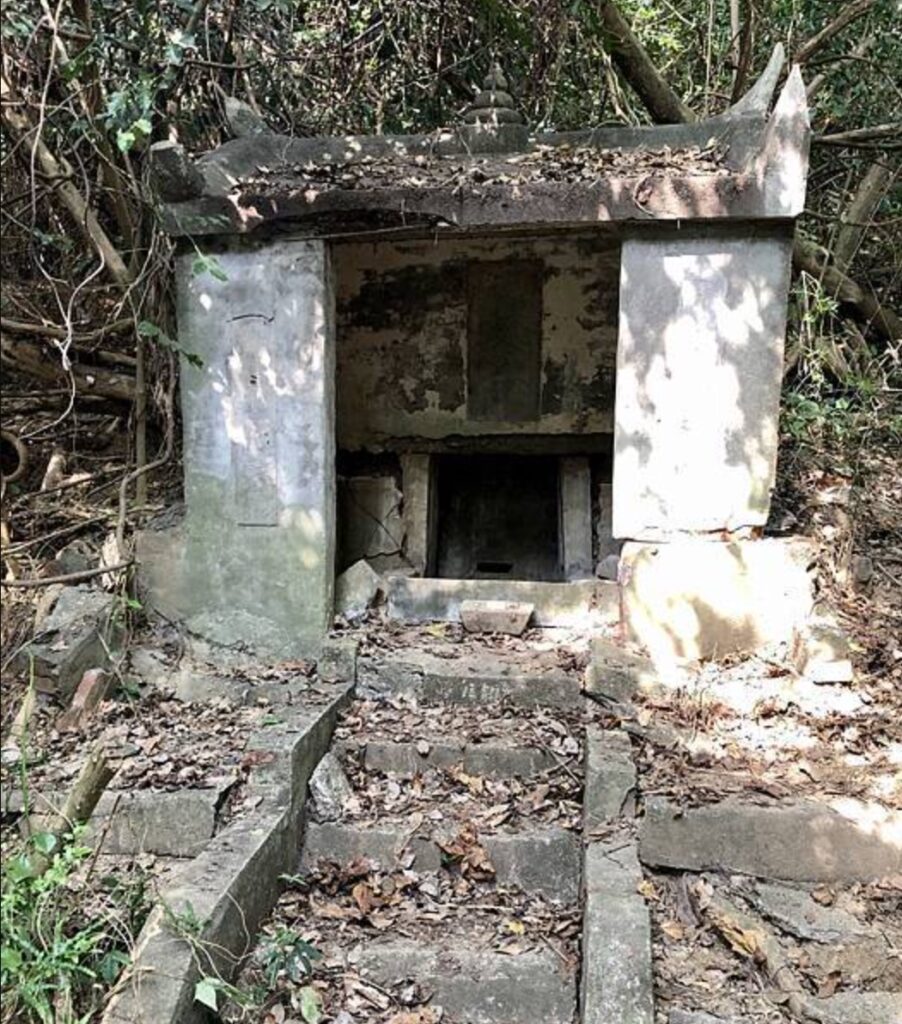
World War II military fortress “Stone Camp” in Xin Kai Village, Fangliao Township.
“The site selection here is also a mistake,” says Lin Xuanyao, the coordinator of the alliance. He compares the significance of Stone Camp to military relics like those on Iwo Jima and Saipan, emphasizing its research and military tourism value, stating that it is “absolutely not for building solar panels.”
The Pingtung County Cultural Affairs Department mentions that Stone Camp did not pass the cultural heritage review and is up for re-evaluation this year.