
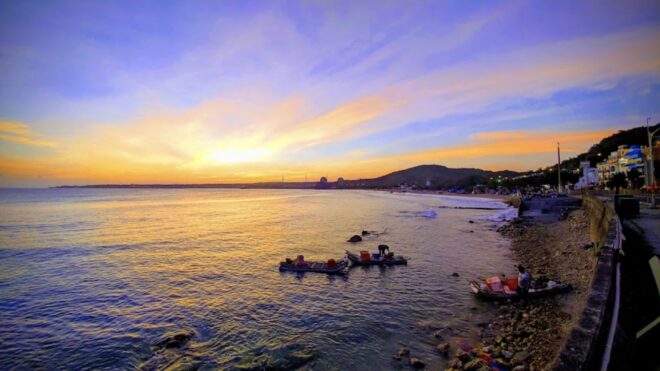
The coastline of Kenting National Park is long, approximately seventy kilometers, starting from the Guishan on the west coast, passing through Nanwan, Kenting, Sail Rock, Eluanbi, and reaching near Nanren Bay on the east coast. Besides eight sandy beaches distributed along the coastline, the rest are coral coastlines.

Tiaoshi (眺石潮間帶) intertidal zone is the area between the high tide and low tide lines. It’s where the sea meets the land. When the tide rises, it’s submerged; when it recedes, it’s exposed to the air. Due to the two daily high and low tides, the environment of the intertidal zone changes dramatically; thus, the organisms here usually have specialized adaptive capabilities.

Tiaoshi Intertidal Zone is a Marine Protection Area within Kenting National Park
When the tide recedes, there will be many large and small pools. In this environment, due to the strong sunlight during the day, the evaporation of seawater increases, or after the rain, the viscosity of the seawater decreases. Organisms living in this area may have developed special structures or behaviors in response to these drastic environmental changes.
The intertidal zone is where seaweeds flourish. As seaweed growth changes seasonally, so does the appearance of the intertidal zone. The so-called intertidal zone refers to the area between the highest and lowest tide lines. In the rocky coastal areas of this national park, when the tide goes out, many tide pools and narrow crevices are revealed.

Tide pools in Tiaoshi
Some of these are closer to the sea, allowing rhythmic waves to flow in, while others are temporarily separated from the ocean. During low tide, whether day or night, the creatures here are exposed to drastic environmental changes, such as increasing salinity or reduced salinity after rain, and the influence of waves. As a result, these creatures have special structures or behaviors to adapt to this environment.

Solasteridae have a small circular or pentagonal oral disc from which arms grow, typically five or six. They mainly feed on small plankton or organic particles in the water. Most solasteridae have distinct genders, though a few are hermaphroditic. Fertilization happens in the water. The fertilized eggs develop into planktonic larvae, which after some time, settle to the seabed to become young solasteridae.
Like sea stars, they have strong regenerative abilities and belong to the class Ophiuroidea of the phylum Echinodermata. They don’t have an anus, so they expel indigestible material through their mouths. Their tube feet on the arms are not well-developed and primarily serve sensory or respiratory functions.
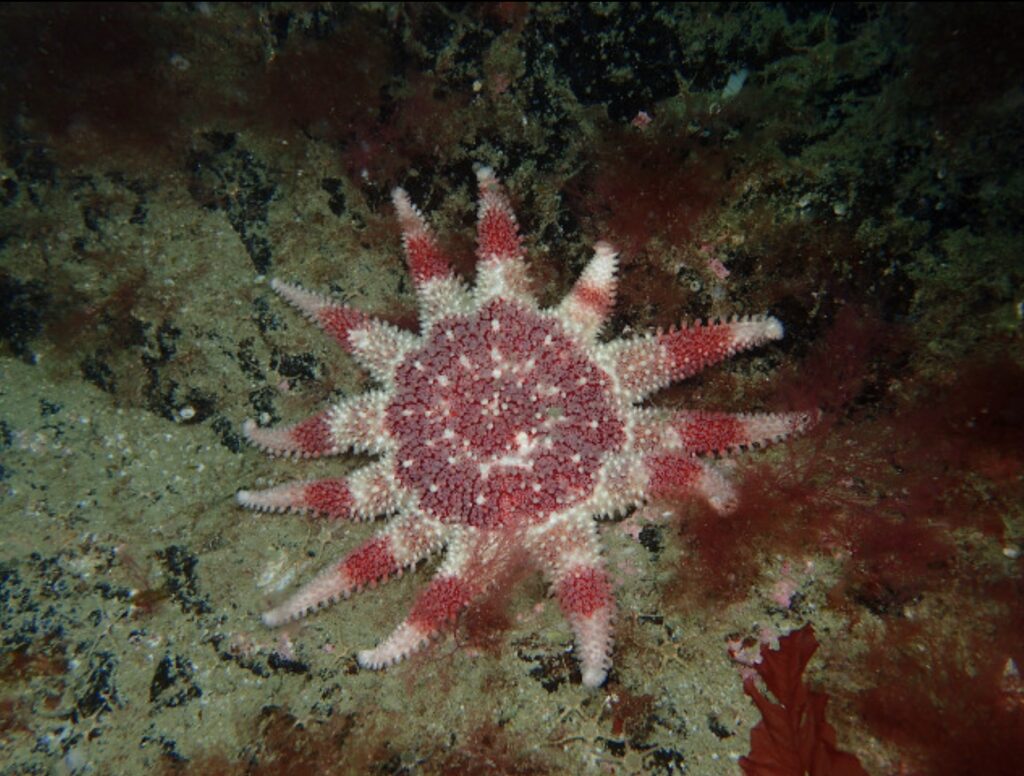
Solasteridae (image source).
Holothuroidea are mostly black, and a few are slightly purplish-black. They can grow up to forty-six centimeters and live in groups in tide pools. Their internal white thread-like Cuvierian tubules are very developed. When threatened, they expel a sticky substance to trap predators. They mainly feed on organic materials in coral sand, often hiding their back ends in coral crevices while using their tentacles to gather coral sand. They are commonly found in coral reef tide pools.

Caulerpa lentillifera, or sea grapes, stand erect with thin membranous, fan-shaped bodies with curled edges. Due to a thicker calcareous layer on the ventral side, they appear greyish-white, while the dorsal side is yellowish-brown due to less calcification. They perennially reside in rocky marshes.

Black-edged rock oysters are typically attached to rocks and are often consumed by people. They have a shell length of about three to five centimeters, grey in color, with a sharp, wavy, purple-black edge. They have large gonads and, during the breeding season, can release tens of millions of sperm or eggs for external fertilization. Once the fertilized eggs develop into larvae, they attach to a suitable substrate and filter-feed on plankton to grow.
According to the survey, there are currently more than 130 types of seaweed in the Kenting National Park. Seaweeds can be found almost all year round, except for those that are sensitive to the intense conditions of summer.

Black Oysters in Tiaoshi
This is the black oyster, commonly referred to as the wild oyster in layman’s terms. It is a sessile organism, meaning it spends its entire life attached to one place and cannot move. April and May are the months when the oyster is at its most plump and delicious.

Also, there are a lot of hermit crabs living in the Tiaoshi Intertidal Zone. However, please remember not to pick up shells so as not to leave the hermit crabs homeless, do not be like this spoiled kid. Also, remember about the mysterious hermit crab killer that we wrote on our site earlier, these small guys deserve to be protected.
How do you find Tiaoshi Intertidal Zone?
in fact, as you can see, it is actually in Nanwan area, not exactly at the Nanwan beach, but at the far corner of it – yes. So, when you drive down from Nanwan, drive slowly and look right for this sign:
Basically, if you are familiar with Nanwan Beach Area, then you can see it from this picture in the upper right corner, as well as the landmark – Maanshan Nuclear Plant at the horizon as well.
Tiaoshi 眺石 – refers to the intertidal zone, a unique ecosystem located between the high and low tide marks along coastlines. Both marine and terrestrial elements influence this dynamic area. As tides rise and fall, the conditions in this zone can change drastically, making it a challenging environment for the organisms that call it home.
From various marine plants to specialized creatures that have adapted to extreme conditions, the Tiaoshi is a fascinating subject of study and an essential part of coastal ecosystems. Whether you’re a casual beachgoer or an avid marine biologist, the intertidal zone offers a window into the incredible adaptability and diversity of life on our planet.