

Some are enamored with flowers, others with butterflies, and then some dedicate their entire lives to protecting them. Chia-lung Chan 詹家龍 fell in love with butterflies as a child and has been chasing them for over 30 years, particularly the Purple Crow butterfly. This butterfly, commonly seen in Taiwan, migrates with the seasons and temperature changes. The overwintering Purple Crows each year form the ‘Purple Butterfly Valley’ in the mountains, a globally unique spectacle that stands alongside Mexico’s Monarch butterfly reserves. However, global warming and human development have gradually shrunk their habitats, leading to a continuous decline in the number of butterflies overwintering.

Purple Crow Butterfly
Out of love for the Purple Crow, Chia-lung Chan 詹家龍 spent five years and millions of dollars to capture the subtle changes in the butterflies using high-speed cameras, producing the documentary ‘The Disappearing Purple Crow Butterfly’.
The production team recently launched a fundraising campaign to cover the substantial post-production and distribution costs. Chan explains that the narrative of the documentary is ‘accessible,’ allowing those unfamiliar with the Purple Crow butterfly to watch it without barriers, ‘I want the world to know that Taiwan once had so many Purple Crow butterflies, and I hope that those who watch the film can live as freely and effortlessly as the butterflies themselves.’

Chia-lung Chan 詹家龍 with his high speed camera
From a young age, he developed a fondness for butterflies, treating Purple Crow butterflies as if they were family
In fifth grade, Chia-lung Chan 詹家龍 received a butterfly field guide from his aunt, which sparked his love for butterflies. He is a man of few words, often pausing for several seconds to think before speaking. Simple sentences frequently require multiple pauses to complete, and he sometimes digresses. However, when it comes to butterflies, his spirit lights up. He can detail various butterfly characteristics and habitat specifics as if recounting treasures from his own home.

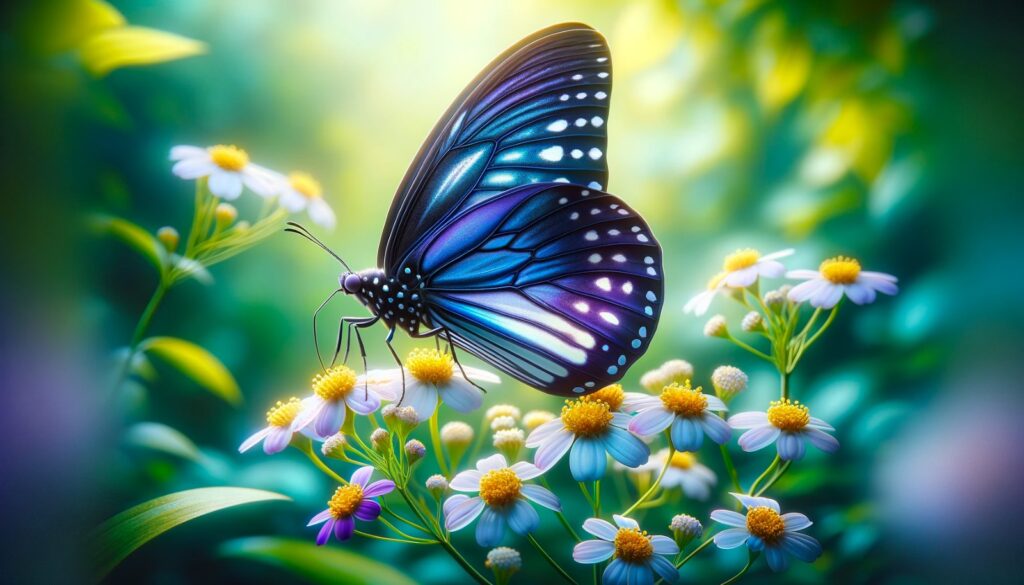
Chan filmed the documentary ‘The Disappearing Purple Crow Butterfly’ to capture their beautiful form. The picture shows the Striped Blue Crow Butterfly.
His life seems to have been lived for the sake of butterflies—going out mostly to observe them, studying entomology in college, and focusing on butterflies in his doctoral research. However, it wasn’t until much later that the Purple Crow butterfly truly entered his heart. Chia-lung Chan noted that Purple Crow butterflies are everywhere; in high school, he saw tens of thousands in Maolin, Kaohsiung, so numerous they seemed like ‘trash butterflies,’ not particularly special. Thus, in his early years, he focused his efforts on finding rare butterflies.
More than a decade later, while helping a friend film Purple Crow butterflies, he revisited Maolin only to find that the places once teeming with them had been turned into parking lots. It took several attempts to find clustering Purple Crows.
This experience deeply moved him, ‘To me, Purple Crow butterflies are like family. You see family often, but losing them is very painful.’ From that point on, Chia-lung Jan began his life dedicated to pursuing Purple Crow butterflies.

The Purple Butterfly Valley in Taiwan is renowned, on par with Mexico's 'Monarch Butterfly Valley.
When the Purple Crow butterfly flutters its wings, the scales on the wings refract the sunlight to display dazzling shades of light purple, vivid purple, or bright blue. Taiwan is the northernmost country in the world where Purple Crow butterflies are found. They prefer temperatures above 15°C and breed across Taiwan during spring and summer. The Tropic of Cancer divides Taiwan into tropical and subtropical climates, and in winter, the Purple Crow butterflies migrate like migratory birds to the south to overwinter, forming the unique ‘Purple Butterfly Valley.
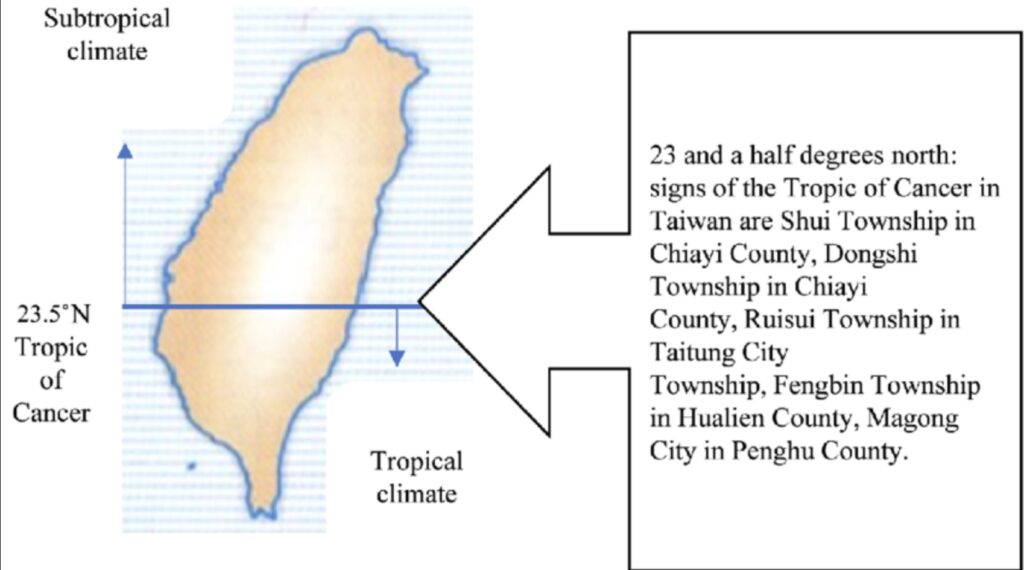
Tropic of Cancer in Taiwan – Kenting is already in a tropical climate zone.
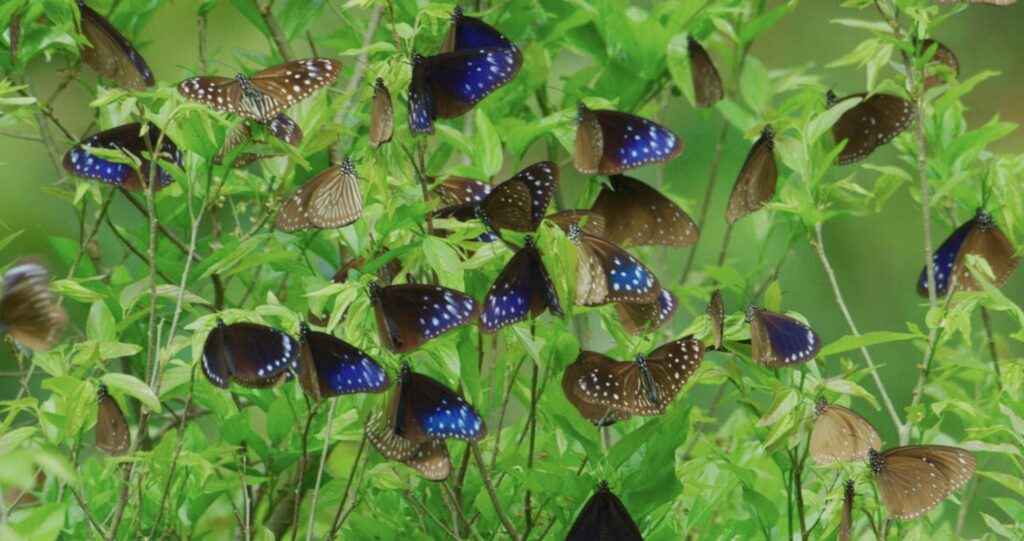
The Purple Butterfly Valley, where tens of thousands of butterflies gather, is a breathtaking sight.
Mobilizing a group of people to chase butterflies together, advocating for the national highway to make way for the Purple Crow Butterfly
Chasing butterflies may sound romantic, but it’s very hectic. “At first, I was so stunned that I would drive after the Purple Crow Butterfly whenever I saw one,” says Chan Chia-Lung as he recalls with a laugh. Butterflies can easily fly over several mountains with a flap of their wings, but humans can’t fly.
When the Purple Crow Butterfly flies over a mountain, he and his researchers have to drive along the mountain roads for several hours in a desperate chase. “I later realized that chasing butterflies is very difficult for one person; you need a group to be able to record them completely.

To chase butterflies together, first, you need companions. Since 2000, Chan Chia-Lung has taken on ecological research and restoration work commissioned by the government, actively promoting the training of Purple Butterfly volunteers, giving lectures everywhere, and organizing events. “I used to only talk to butterflies. After doing conservation, I started talking to people.” In 2007, he gathered the strength of many and advocated for the “National Highway for Butterfly Passage” initiative.
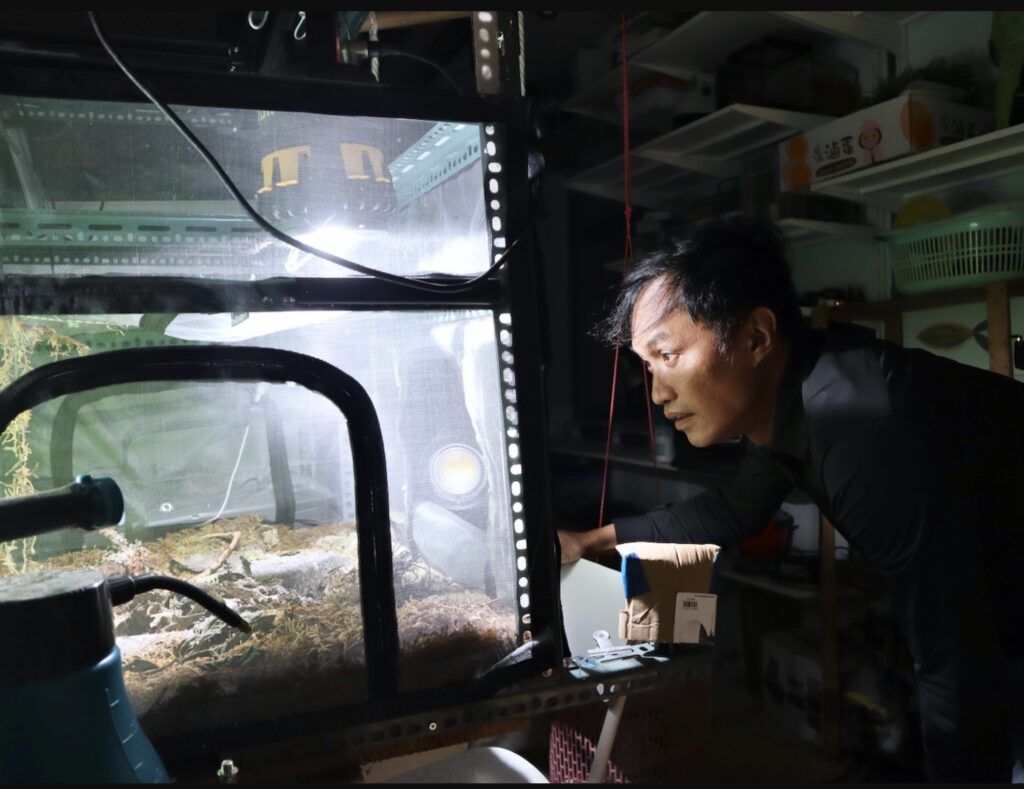
Chia-Lung’s studio also has a small set scene for convenience in work at any time
Since then, around the Tomb Sweeping Day each year, guardrails are set up on the Linnei section of National Highway No. 3 for the northward-returning Purple Crow Butterflies, and the outer lanes are closed if necessary.
Capturing the myriad expressions of the Purple Crow Butterfly, an obsession unmatched by others
The documentary “The Disappearing Purple Crow Butterfly,” which took Chien Chia-lung five years to film, is still in production and is expected to premiere before the end of this year, hoping that everyone who sees it will fall in love with the Purple Crow Butterfly.
“High-speed cameras can capture all the details of the Purple Crow Butterfly, and I have come to realize that butterflies have expressions,” he says. Under the lens, the Purple Crow Butterfly can change into 17 different colors in 0.1 seconds, and the chrysalis can also change into 17 different colors within a week.
The documentary “The Disappearing Purple Crow Butterfly,” which took Chan Chia-lung five years to film, is still in production and is expected to premiere before the end of this year, hoping that everyone who sees it will fall in love with the Purple Crow Butterfly. “High-speed cameras can capture all the details of the Purple Crow Butterfly, and I have come to realize that butterflies have expressions,” he says. Under the lens, the Purple Crow Butterfly can change into 17 different colors in 0.1 seconds, and the chrysalis can also change into 17 different colors within a week.
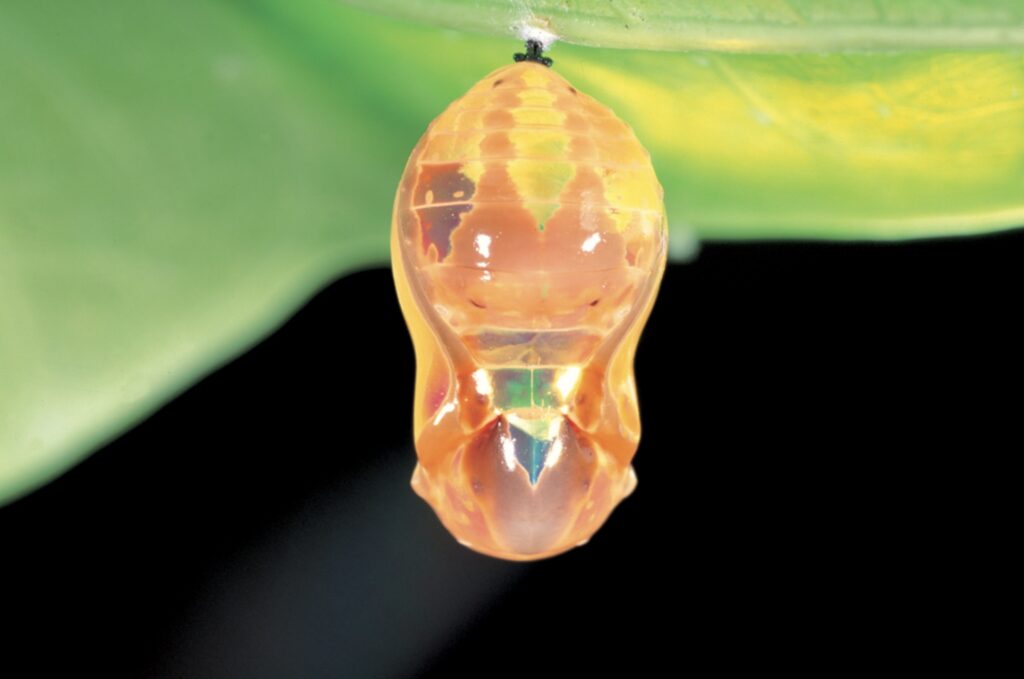
A chrysalis of purple crow butterfly
Filming the Purple Crow Butterfly is not easy. Hsu Chih-hao, the first chairman of the Purple Crow Butterfly Conservation Association, also participated in the filming of this documentary. He explains the three key scenes: overwintering, northward return, and breeding. The breeding scenes are the easiest to shoot, while overwintering and northward return are “tests of temperature and timing.” For overwintering, the better the weather, the less likely the butterflies are to cluster.
Large groups of Purple Crow Butterflies usually migrate when a cold front hits the north, and filming must be done in cold and windy conditions. The northward return usually occurs from mid-March to mid-April, but the precise timing of large gatherings is difficult to predict, requiring frequent weather checks and observations of numbers.

During the filming, Hsu Chih-Hao was particularly struck by a scene where a vast number of Purple Crow butterflies flew up and down, following the sun’s emergence and retreat—a truly magnificent sight.
The Purple Butterfly Conservation Association also played a crucial role in the making of this documentary, with volunteers from various locations reporting back to Chan Chia-Lung. However, since the volunteers have full-time jobs, they usually assist on weekends. “Teacher Chan often goes out for weeks on end to chase and film butterflies, which is really hard work!”
The volunteers respectfully refer to Chan Chia-Lung as “Teacher” to show their respect and describe him with words like “passionate,” “obsessive,” and “possessed.” In Hsu Chih-Hao’s view, no one can match Chan’s sense of mission towards the Purple Crow butterfly. Despite the path of ecological conservation being unprofitable and the income from contract filming being unstable, Chan continues boldly forward. He doesn’t hesitate to invest in expensive equipment for better footage, which Hsu can only describe as “admirable.
Human development destroys habitats, risking the loss of the Purple Butterfly Valley.
The current population of the Purple Crow Butterfly in Taiwan is not as high as it used to be. There were once records of up to 2 million butterflies, but in the past two years, the number has dwindled to just 200,000. “This is because their habitat has diminished,” explains Chan Chia-Lung. Recently, he has observed that the habitat of the Purple Crow Butterfly is gradually shifting to higher altitudes.
This shift is partly due to global warming causing an increase in average temperatures, and partly due to continuous development of factories and houses in the plains of Taiwan. The remaining farmlands are also unsuitable for the butterflies’ survival due to the use of pesticides. “I’m making this documentary to record the fact that Taiwan once had so many Purple Crow Butterflies.”
Originally, Taiwan was home to five species of Purple Crow Butterflies, but the largest and most beautiful species, the Great Purple Crow Butterfly, disappeared in the 1960s. Chan Chia-Lung notes that this extinction coincided with Taiwan’s economic boom, when factories and houses were rapidly being constructed. The Great Purple Crow Butterfly, which mainly inhabited the plains, suddenly lost its home, becoming the first butterfly species to go extinct in Taiwan.
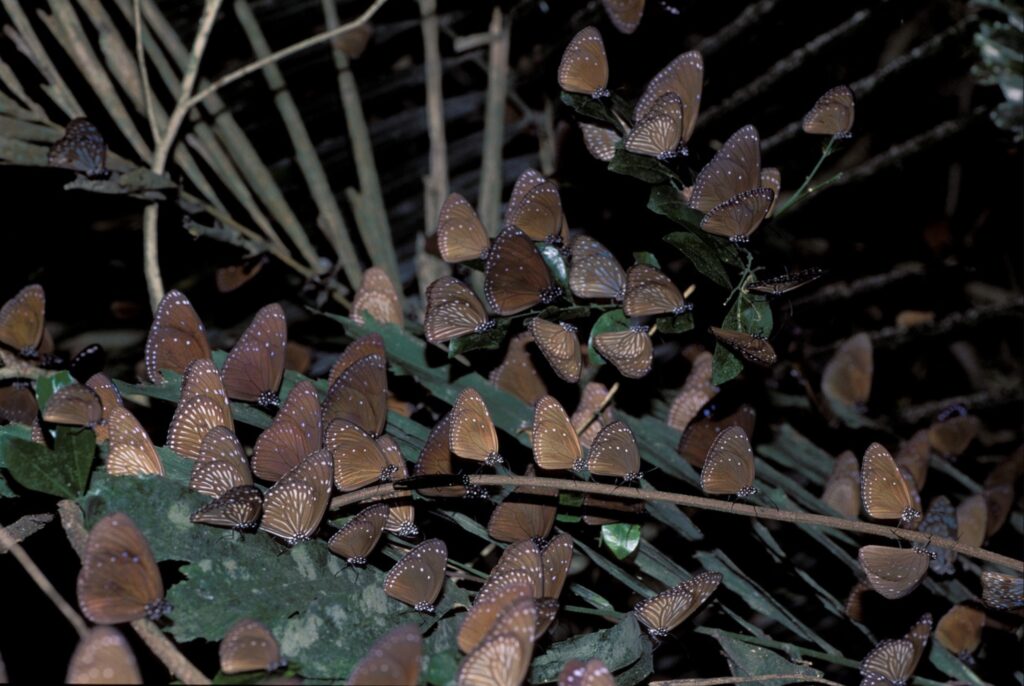
With habitats continuously shrinking, will the remaining four species of Purple Crow Butterflies also disappear? “No, but we will lose the Purple Butterfly Valley,” Chan explains. Due to climate change, the Purple Crow Butterfly may no longer migrate or may fly to other higher-latitude countries. In that case, the Purple Butterfly Valley might only have ten thousand or even five thousand Purple Crow Butterflies left. “It’s such a pity!” he repeats three times, his regret palpable.