
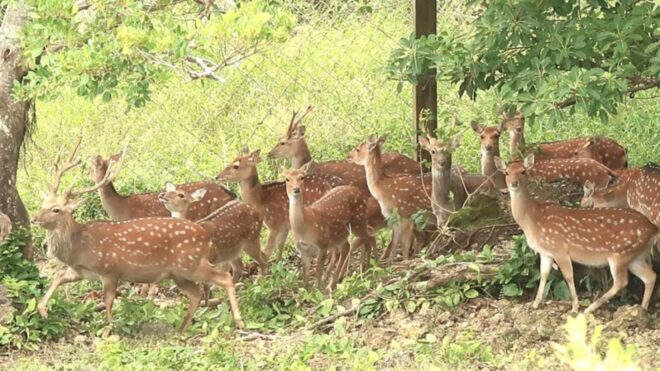
The release of Formosan sika deer during the ecological rehabilitation in Kenting has led to accusations of an overpopulation of deer. This year, the Kenting Management Office (墾管處) will investigate the environment’s carrying capacity and use it as a basis for population control.
Another solution for promoting harmonious coexistence between humans and deer is the “Endangered Species and Important Habitat Ecosystem Service Payment Promotion Plan” initiated by the Taiwan Forestry Research Institute, but eligibility and conditions may not be met.
We already touched a bit on the Sika deer thesis in this article about the Sika deer display in Howard resort in Kenting.
The cute-looking Formosan sika deer in Kenting have not only become a successful case of the domestic wild species being successfully reintroduced but have also brought in tourism revenue to the local area.
However, they have caused agricultural damage, traffic problems, and ecological impact, resulting in accusations of “overpopulation of deer” and “uncontrolled reintroduction”.
The Kenting Management Office said that in addition to setting warning signs in hot zone areas, compensating farmers for crop damage, and providing free fencing, they will first catch and reduce the number of deer in high-density areas.
This year, they will investigate the carrying capacity of the deer population as a basis for population control. As for the “Endangered Species and Important Habitat Ecosystem Service Payment Promotion Plan” which is a solution for promoting harmonious coexistence between humans and deer, eligibility and conditions may not be met.
The Kenting Management Office is responsible for managing and protecting the natural and cultural resources of Kenting National Park, which is located in southern Taiwan.
Its duties include maintaining the park’s infrastructure, managing the ecosystem, protecting endangered species, ensuring public safety, and promoting tourism. The office also collaborates with local communities and stakeholders to achieve sustainable development and promote environmental education. In addition, it conducts research, provides information services, and enforces regulations within the park.
The Kenting Management Office stated that since the launch of the Formosan sika deer reintroduction program in 1984, the process of establishing basic data, facilities, rehabilitation, and reintroduction has resulted in a stable population of 1,500 to 2,000 deer in the wild.
They have become a unique landscape feature of the Hengchun Peninsula. However, as the wild population continues to increase, the negative impacts such as grazing that affects forest regeneration, agricultural damage, and traffic accidents when crossing roads, are not solely due to the number of deer but rather the uneven distribution of their population.

According to the Deputy Director of the Kenting Management Office, Hsu Shu-Kuo 許書國, the goal of the restoration program has been achieved since its initiation in 1984.
However, the challenge now is to manage and maintain the population of the Formosan Sika Deer.
Unlike some other countries such as the United States and Japan, hunting as a means of population control is not allowed under the National Park Law in Taiwan.
Some scholars also suggest that while stable, the current population of 1,500 to 2,000 deer is still not a safe number for a once-endangered species.
In response to the challenges arising from the presence of the Formosan Sika Deer, the Kenting Management Office has implemented various measures, including compensating farmers for crop damage, providing free fencing, installing warning signs in the high-density areas along Route 26 in Kenting, purchasing public accident insurance, experimenting with vaccine sterilization control, and planning to reduce and recover the deer population in densely populated areas. The office will continue to review and adjust its measures.
The Conservation and Research Division of Kenting National Park Management Office stated that the “Kenting High Coral Reef Nature Reserve” established in the Kenting Forest Recreation Area under the Cultural Heritage Preservation Act has a precious and unique high coral reef ecosystem and tropical monsoon forest.
However, it is also the area with the highest population density. The Formosan sika deer have caused severe ecological damage by nibbling and trampling on forest seedlings, rubbing their antlers on trees, and stripping their bark.
Although the Forestry Research Institute has erected forest nets to prevent deer from entering, they cannot fully cope with the situation. In order to prevent the decline of forest ecological functions and biodiversity, the current priority is to relocate the deer population to the nearby Sheding Rehabilitation Area to reduce damage.
This year, an investigation will also be conducted on the deer’s carrying capacity as a basis for future reduction and recovery.
Some scholars suggest that most parties have no conflicts of interest with Formosan sika deer, and that the government can develop Formosan sika deer tourism appropriately by leveraging this situation.
Through guided tours and observation, unique environmental education can be introduced, coupled with the Forestry Bureau’s “Endangered Species and Important Habitat Ecosystem Service Payment Promotion Program” launched on New Year’s Day two years ago, which can create a win-win situation. The Kenting Forest Recreation Area of the Kenting National Park Land Conservation and Rehabilitation Program also periodically promotes guided tours, and community eco-tourism has also included deer watching as part of the itinerary.
Although the ecosystem service payment program is an excellent idea, it is divided into two categories: “endangered species” and “important habitats.”
The former targets four endangered species: the leopard cat, the grass owl, the Eurasian otter, and the Mandarin duck, while the latter targets four important habitat types: paddy fields, terraced fields, land fishponds, and private security forests. The program’s purpose is to protect endangered animals, but the legal status of Formosan sika deer as livestock may make them ineligible.
Update May30, 2023:
On May 30, news came out that a drunken motorcyclist collied with Sika Deer near Sheding Nature Park in Kenting, and both human and deer died on the scene. More on this incident here.
Update June 6, 2023:
A little more research from my side revealed one more case of a car colliding with sika deer in Kenting. Read more about it here.
Update June 7, 2023:
As collision cases near Sheding Park keep happening, now Kenting Village chief Liu Qingming is proposing to install fences near the road at places where deers have the most significant possibility to cross the road.