

What is Downslope Wind in Kenting?
The “落山風” luò shān fēng – downslope wind is a unique weather phenomenon in southern Taiwan. Due to the Central Mountain Range descending to heights of 400 to 1000 meters when reaching the Hengchun Peninsula in Pingtung, the cold and dense northeast monsoon of winter has the opportunity to cross the mountain range and blow towards the western coast of the Hengchun Peninsula, including areas such as Fangshan, Fenggang, and Hengchun. This is referred to as the Taiwans 落山風. or downslope wind.
Is the large and sweet onion, which is abundant in Kenting, related to the local weather?
Yes, the onions produced in Kenting, especially in Checheng Township are large and sweet, and the delicious secret comes from the “落山風” (lòu shān fēng) or the “downslope wind.” Because the downhill wind is very strong, it blows the onion leaves down, forcing the plant to store nutrients in the underground bulbs. That’s why the onions here become incredibly tasty! Read more about onions in Kenting, here.

Graphic Illustration of Downslope Wind (downhill wind) in Hengchun Peninsula
What are characteristics of downslope wind in Kenting?
From October to April each year, strong winds often occur along the west coast of the Hengchun Peninsula. Sometimes these winds last only a few hours, while at other times they can persist for several days.
These strong winds have overturned motorcycles and cars, resulting in injuries and even damaging power facilities. A windbreak was specially constructed on the southern section of the South-Link Railway east of Fangshan to prevent trains from being toppled by these winds.
This strong wind during the cold season in Hengchun is known as the “恆春落山風” (Héngchūn luò shān fēng), which descends along the eastern mountain range of the peninsula. From November 28th to December 1st in the 76th year of the Republic of China (1987), during a strong cold surge, Hengchun experienced four consecutive days of this “落山風,” with maximum wind speeds reaching 37.2 meters per second. This speed far exceeded the minimum wind speed of 33 meters per second for a moderate typhoon, leading to severe consequences such as power poles being knocked over and crops being heavily damaged.
The formation of this strong “落山風” or downslope wind is primarily influenced by the local topography. It is related to the Central Mountain Range, which has an average elevation above 3,000 meters. The elevation of the Central Mountain Range gradually decreases from north to south (see picture above), with the heights around Kaohsiung and Pingtung being approximately 1,500 meters, and even lower towards Dawu at around 400 meters.
Due to the Central Mountain Range’s considerable thickness of about 1,500 meters, the large-scale northeasterly winds from the northeast cannot cross the mountains. As these winds encounter the southern end of the Central Mountain Range, where the elevation suddenly drops and the southwestern part acts as the windward side, warm lower-level air and lower air pressure cause the cold dense air from the north to rush down the mountain ridges, forming the robust Hengchun Downslope Wind.
What are the effects of downslope wind to agriculture and transportation in Kenting and Hengchun pensinsula?
The downslope wind significantly impacts local transportation, agriculture, and construction. Given its unstable mountain waves and turbulence, aircraft cannot fly at low altitudes over the area due to the risk of crashing into mountains or the ground. Therefore, airports are not advisable to be constructed on the Hengchun Peninsula, and this is partially the reason for the struggles of the Hengchun Airport. The gusts can also knock over motorcycles and cars, resulting in casualties.
The prolonged gusts hinder the pollination and fruit-setting of various crops and fruits, causing trees to lose their leaves and branches. To combat the “落山風,” downslope wind, houses should utilize sealed aluminum windows and doors. In November 1987, during a strong cold wave, the Hengchun Peninsula experienced four consecutive days of intense downslope wind “落山風.” On November 29th, the maximum wind speed reached 37.2 meters per second. As a result, power lines were blown down, causing power and water outages. Over 70% of crops were either knocked down or suffered severe damage, highlighting the significant losses incurred. Therefore, the power of the downslope wind should not be underestimated.
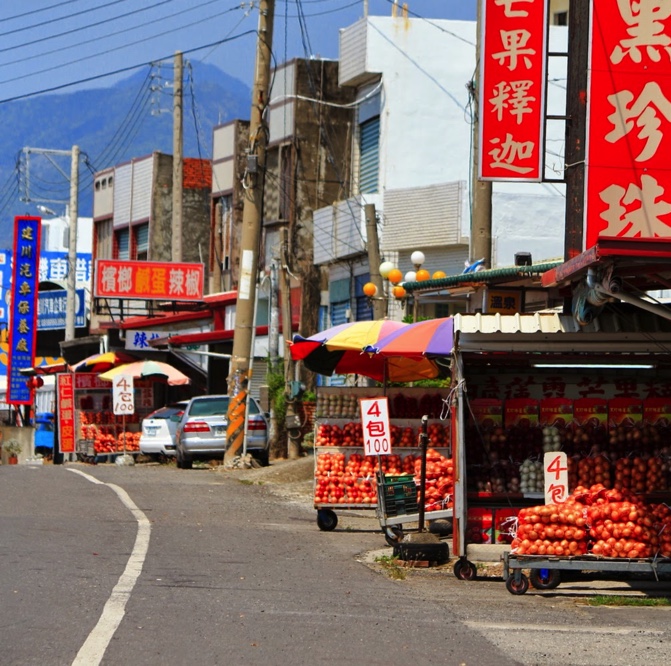
However, due to the downslope wind, Hengchun’s onion industry can strive, and when you drive the Ping-E highway, you will likely see many of these onion stands.