
Home » Checheng Township
Checheng Township
Checheng Township (車城鄉), pinyin: Chē Chéng Xiāng, also known as Chhâ-siâⁿ-hiong in Taiwanese and written as 柴城鄉, is situated on the southwestern side of Pingtung County in Taiwan.
It shares borders with Fangshan Township, Shizi Township, and Mudan Township to the north, while its southeastern boundary is with Manzhou Township.
To the west, it faces the Taiwan Strait, and to the south, it is adjacent to Hengchun Township.
The geographical location of Checheng Township lies within the Hengchun Peninsula, characterized by gently rolling hills as its predominant topographical feature.
The Sichong River and Baoli River traverse the township. Its climate falls under the classification of a tropical monsoon climate. Notably, from October to February of the subsequent year, the area experiences the influence of vigorous downslope winds due to its unique terrain.
Checheng Township is divided into three main geographical areas: the eastern hilly region, the western plain area, and the coastal plain.
The eastern hilly region represents the southern end of the Central Mountain Range, with elevations mostly below 400 meters.
The highest peak in the township is located on the southern shoulder ridge of Mount Wenzhao, with an elevation of approximately 635 meters. This peak marks the boundary between Checheng Township and the neighboring Shizih Township and Mudan Township.
The largest plain in the township is the northern section of the Hengchun Valley Plain, mainly formed by the sedimentation of the Sichong River and the Baoli River. This plain serves as the primary agricultural area of the township and is known for its onion production.
The Sichong River Valley Plain stretches approximately 5 kilometers in length, with an average width of around 800 meters. It reaches its widest point at the confluence of its tributary, the Damei River, with a width of about 1,200 meters.
Main Industries in Checheng
Checheng Township’s main industries revolve around agriculture and fishing, making up the primary sources of income for the local community.
About 31% of the township’s population is involved in farming. However, when it comes to other sectors like manufacturing and commerce, it’s a bit challenging for the township due to its remote location and limited resources.
In the flat areas of the township, farmers take advantage of irrigation to grow crops like onions, watermelons, and rice.
The township is famous for its delicious and juicy onions and sweet watermelons grown in large quantities. On the other hand, the hilly regions have rocky soil and limited water, making it difficult to cultivate crops.
The locals proudly call Checheng Township the “Onion Kingdom” because onions are their main crop.
The climate is just right for onions to thrive, and the strong winds that blow from the mountains keep pests away and help the onions mature. These onions have a shorter growing period, but they are extra flavorful and loved by people both near and far.
Checheng Township is also known for its early harvest of watermelons.
The soil is perfect for growing these refreshing fruits, and the local farmers have mastered the art of producing large and sweet watermelons.
You’ll find the watermelon fields near the Sichongxi hot springs. It used to be a booming industry in the past, but the scale of watermelon cultivation has reduced over the years.
With its long coastline, fishing is another important industry in Checheng Township. Local fishermen use small boats to catch various types of fish. They also have fish farms where they raise eels, sea bass, and prawns. Fishing plays a vital role in the local economy, and you can find a wide variety of fresh seafood in the township.
So, in a nutshell, farming, fishing, and unique products like onions and watermelons define the industries of Checheng Township. The locals take great pride in their agricultural heritage and continue working hard to provide the best produce for everyone.
Main attractions and places to see in Checheng Township
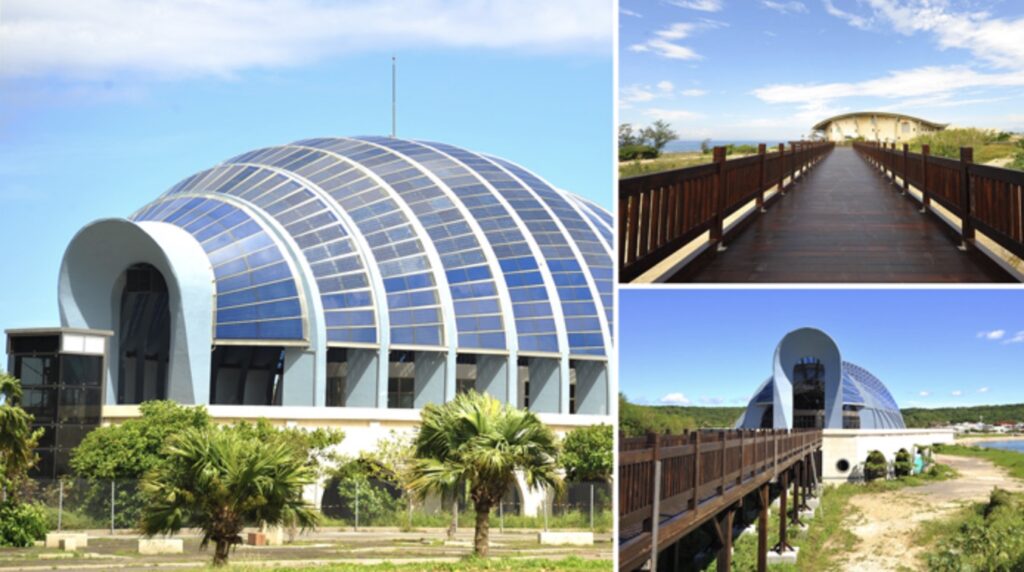
National Museum of Marine Biology and Aquarium
The National Museum of Marine Biology and Aquarium is located in Houwan Village at the southwestern tip of Checheng Township.
It is situated in the coastal area at the foothills of Gueishan Mountain in the northwest corner of Kenting National Park. The museum, covering an area of approximately 96.81 hectares, focuses on marine biology and serves as a large-scale museum. It is divided into three main sections: Taiwan Waters, Coral Kingdom, and World Waters, with additional facilities such as an educational center and an aquarium research center.
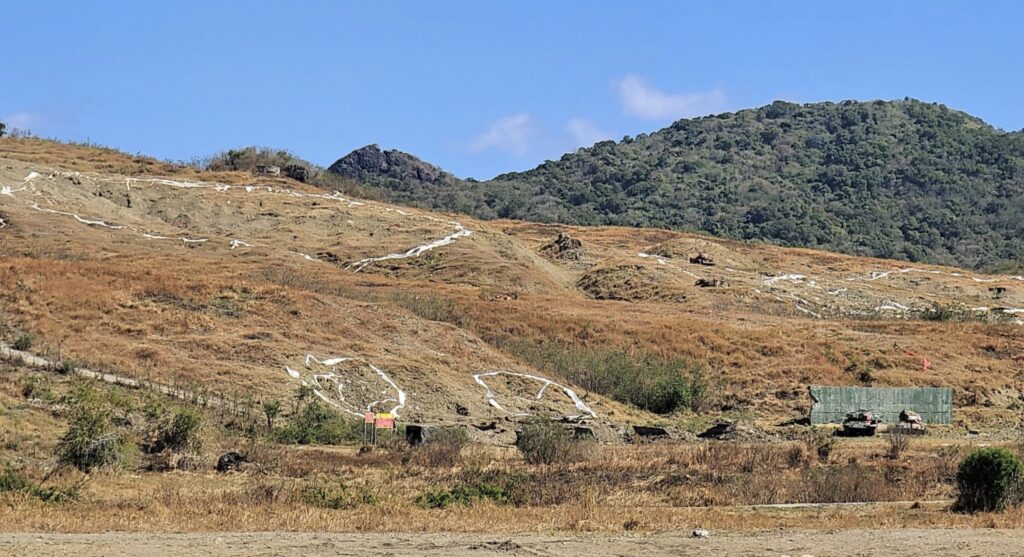
Baoli Forest Recreation Area
Baoli Forest Recreation Area is located on Zhusheluo Road in Baoli Village and is a forest recreation area under the jurisdiction of National Pingtung University of Science and Technology.
It covers an area of approximately 291.74 hectares. Situated in the mountainous region, the Baolai Forest Recreation Area is traversed by Zhushesi Creek and Shibankeng Creek, which converge to form the Baoli Creek in front of the main office building.
The vegetation in the recreation area is predominantly tropical plants, with trees generally being shorter due to high temperatures and strong winds.
The main species cultivated in the area are Acacia confusa. Still, in recent years, some precious tree species such as Dalbergia sissoo, Dendrocalamus latiflorus, and Diospyros lotus have also been introduced. Wildlife such as Cattle Egret, Azure-winged Magpie, Red-billed Blue Magpie, Crested Serpent Eagle, Baboon Spider, Chinese Cobra, and Green Snake can often be seen in the area. Additionally, the charcoal kiln in the Baolai Forest Recreation Area is a rare traditional craft facility.
Sichongxi Hot Spring
Sichongxi Hot Spring is located in the Sichongxi settlement of Wenquan Village and belongs to the sedimentary rock hot springs category based on geological classification.
The hot spring features alkaline sodium bicarbonate mineral water that is clean and odorless, rich in minerals. Developed during the Japanese colonial period, it gained fame when Prince Takamatsu and his wife visited the area for their honeymoon.
It was once listed alongside Beitou Hot Springs, Grass Mountain Hot Springs (Yangmingshan Hot Springs), and Guanziling Hot Springs as one of the “Four Famous Hot Springs in Taiwan” during the Japanese colonial period.
Checheng Haikou Harbor
Checheng Haikou Harbor is located in Haikou Village, at the northernmost point of the Hengchun Valley Plain, where the ocean, plain, and mountains intersect.
Originally a small fishing port, it gained fame for its proximity to the former “Haikou Desert” landscape. In recent years, it has been planned and renovated by the Pingtung County Government to transform into a tourist fishing port and serves as the endpoint of the “Blue Highway” in the Kaohsiung-Pingtung area.
Visitors can travel by boat to Xiao Liuqiu Island and Fengbitou Harbor in Kaohsiung. Although the Blue Highway has not officially operated since its inaugural ceremony, it attracts visitors for recreational activities due to the completion of surrounding facilities during weekends and holidays.
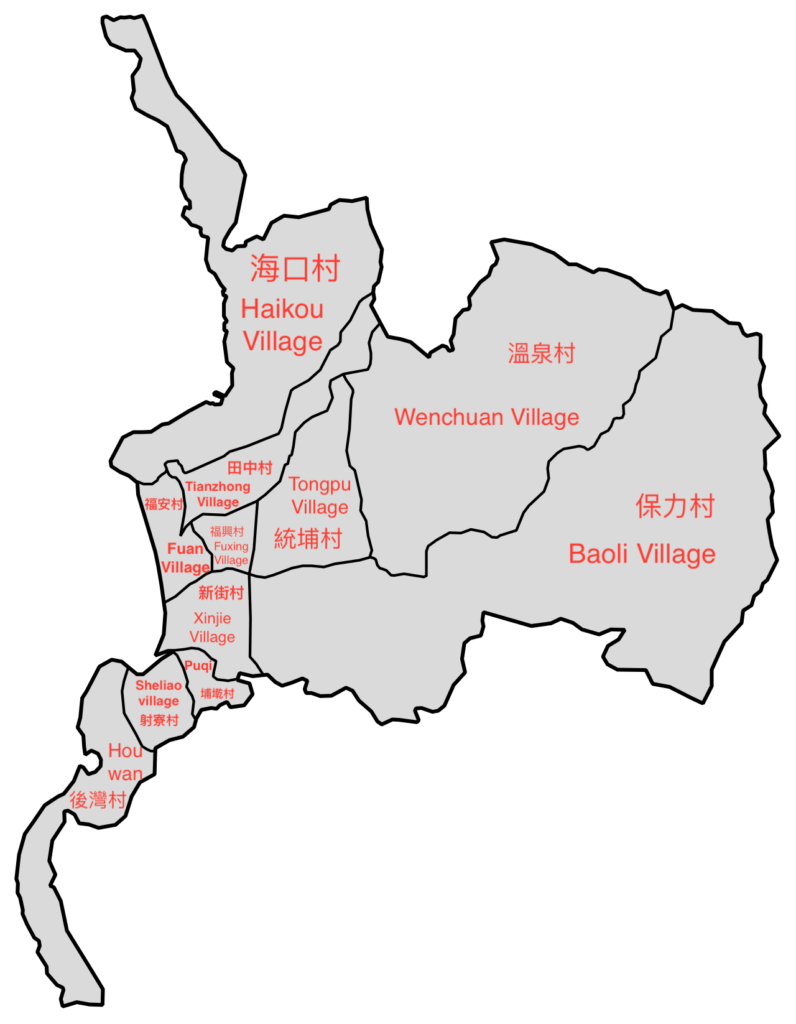
Checheng Township Administrative Divisions
The Checheng Township Office is the highest-level local administrative institution in Checheng Township.
Within the framework of the government structure of the Republic of China, it serves as the administrative authority for local self-governance and is responsible for executing tasks assigned by the county government and central agencies.
The supervisory authority overseeing the autonomy of Checheng Township is the Pingtung County Government. The township chief is elected directly by all township residents and serves a four-year term, with the possibility of being re-elected once. The Checheng Township Office also convenes township council meetings, which serve as the highest decision-making body for township affairs. Under the leadership of the township chief, the office consists of eight internal units, including five divisions and three departments, as well as four affiliated agencies, and has the following villages as its administrative divisions:

Map of Locations and Borders of Chencheng Administrative Divisions (Villages)
History of Checheng Township & County
When the Dutch were in Taiwan, they sent troops to control the area which is nowadays Chengcheng and other areas in Taiwan.
In the Ming dynasty, Checheng was inhabited by Paiwan people, and it was initially a forest; the local aborigines called it “Kabeyawan” (KABEYAWAN), which was then pronounced as “ku-piah-uan” in the Southern Min dialect.
In the Yongli 18 (1664), Zheng Jing (鄭經) succeeded Zheng Chenggong (鄭成功) as a leader of Taiwan; he dispatched the troops to land on Checheng and began to reclaim the land.
He ordered the commander of the army to march south into “ku-piah-uan” to the garrison, and the place was named “Tonglingpu” (Tongpu Village of present-day) before it gradually formed a village.
From the end of the Kangxi Period to the Yongzheng Period, Checheng had become the base of the Min Chinese speakers to start up the Hengchun Peninsula; due to repeated attacks and intrusions by the indigenous people, they planted wooden fences around the perimeter as a defense, and hence Checheng was also known as “Firewood City” or “Chaicheng”.
In the last years of the Qianlong Period, when there was a chaotic period, and when General Fu Kang’an (福康安) led an army to attack Zhuang Datian (莊大田) as a party gang of Lin Shuangwen (林爽文) in Qianlong 53 (1788), the water division landed at Checheng, and then they called Checheng “Fu’an Village” (or Fu’an City) to commemorate the victorious army, in addition to establishment of a monument to praise the merits at the Fu De Temple of the village.
As for the name “Checheng”, Inō Kanori believed that it was a mispronunciation of “Chaicheng”, and another theory referred it to the massive cutting and export of fuelwood at early Checheng to the Tainan area, and the villagers used it as a fortress to repel the indigenous people, so it was called “Firewood City” or “Chaicheng”.
Later, a large attack ensued during the period when charcoals were manufactured on the coast between Checheng and Haikou, and dozens of ox carts carrying charcoal were lining up.
The villagers used the ox cart as a defense to repel the attack; therefore, “Firewood City” or “Chaicheng” was renamed “Car City” or Checheng.
Although Checheng was not officially established, the wooden fence of surrounding was designed to have East Gate, North Gate (Beimen Road and Zhongxiao Road Junction), and South Gate (near the bridge “Qinhu Qiao” at the end of Fu’an Road) to ensure access to entry and exit.
It is also said that during the three years of Qianlong 51 to 53 (1786-1788), to suppress Zhuang Datian (莊大田), General Fukang’an (福康安) stationed at Checheng, and because of the wood as the city, Checheng was called “Firewood City”.
The part of the city street of Checheng of present-day is divided into the two villages, Fuxing and Fu’an. In July of Kangxi 22 (Yongli 37 of Ming dynasty), Zheng Keshuang (鄭克塽) surrendered to the Qing dynasty, and until Kangxi 23, Taiwan was incorporated into the territory of Qing; in April, the Taiwan Prefecture was established, and it belonged to Fujian Province, under the settlement of three counties (Taiwan, Fengshan, and Zhuluo). This township is under the jurisdiction of Fengshan County.
In Kangxi 35, the Min Chinese speakers successively moved to the Checheng area, and then established villages such as Xinjie, Sheliao, Puqi, and Houwan, etc., on the seashore two or three kilometers to the southwest of Checheng.
In Guangxu 18 (1892), the area of Hengchun County was divided into 13 villages. The township belonged to Xingwenli (Fuxing Village, Fu’an Village, Tongpu Village, Baoli Village, Tianzhong Village, and Haikou Village of present-day), Renshouli (Xinjie Village of present-day), Xianchangli (Wenquan Village of present-day) and Deheli (Houwan Village, Puqi Village, and Sheliao Village of present-day).
In the 37th year of The Meiji era (1904), this township belonged to Hengchun Hall, and the township was subordinated to Xingwenli, Xianchangli, and Deheli. Xingwenli had jurisdiction over Checheng village (Fuxing Village and Fu’an Village of present day), Tongpu village (Tongpu Village of present-day), Baoli village (Baoli Village of present day), Tianzhongyang village (Tianzhong Village of present-day, Haikou Village), Xinjie village, and Zhanzhan village (Xinjie Village of present-day).
Xianchangli had jurisdiction over Sichongxi village (Wenquan Village of present-day); Deheli District had jurisdiction over Puqi village (Puqi Village of present-day), Houwan village (Houwan Village of present-day), and Sheliao village (Sheliao Village of present-day).
Subsequently, Hengchun Hall was changed to Hengchun Branch Office, and the township was still subordinated to Xingwenli, Xianchangli, and Deheli, of which Xingwenli had jurisdiction over Checheng village (Fuxing Village, Fu’an Village, Tongpu Village of present-day), Baoli village (Baoli Village of present day), and Tianzhongyang village (Tianzhong Village, Haikou Village, and Xinjie Village of present-day). Xianchangli had jurisdiction over Sichongxi village (Wenquan Village of present-day), and Deheli had jurisdiction over Sheliao village (Houwan Village, Puyuan Village, and Sheliao Village of present-day).
In the ninth year of Taishō (1920), the Japanese replanned the administrative area. The township belonged to Hengchun County of Kaohsiung Prefecture. It was divided into 7 larger sections: Checheng (Fuxing Village, Fu’an Village, Tongpu Village of present-day), Baoli (Baoli Village of present-day), Tianzhongyang (Tianzhong Village of present-day), Haikou (Haikou Village of present-day), Xinjie (Xinjie Village of present-day), Sichongxi (Wenquan Village of present-day), and Sheliao (Houwan Village, Puqi Village, and Sheliao Village of present-day). In the thirty-fourth year of the Republic of China (1945, after World War II), Checheng village was re-divided into Fuxing and Fu’an villages. Together with Tianzhong Village (formerly known as Tianzhongyang), Wenquan Village (formerly known as Sichongxi), Houwan Village (formerly known as Houwan), Tongpu Village, Haikou Village, Baoli Village, Xinjie Village, Puqi Village, and Sheliao Village, all of which in total there were eleven villages; they were under the jurisdiction of Checheng Township.
Emblem of Checheng Township
The “City Gate” as center with “temple” like style presented the origin of the name of Checheng Township.
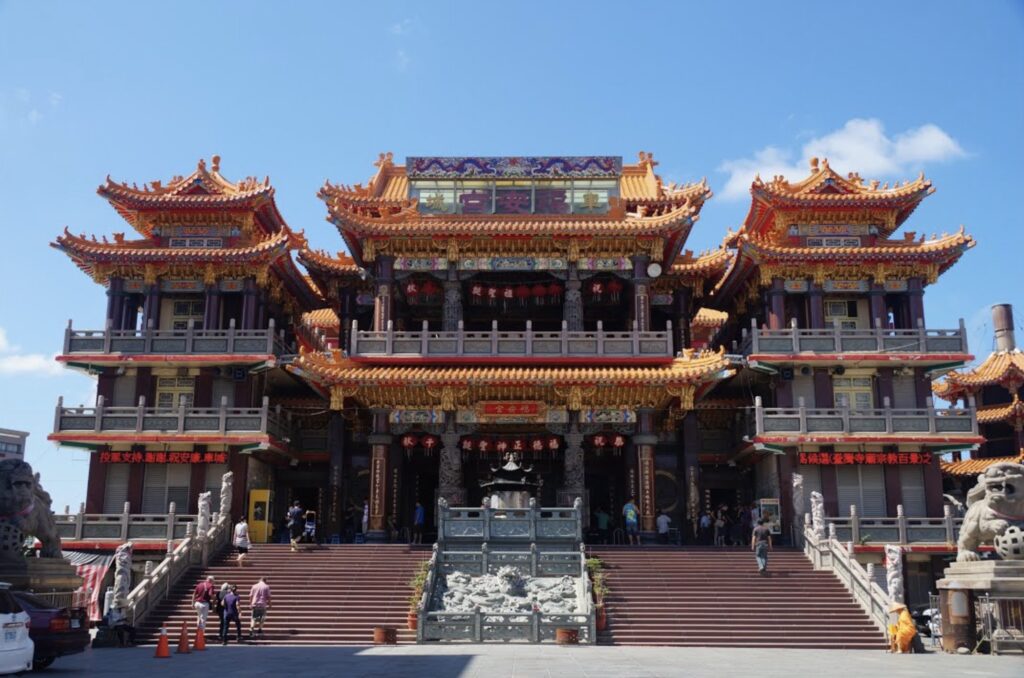
The “Fu’an Temple” served as the center of religious belief for villagers of which it used the color of red brick which conveyed the meaning of the historical inheritance, and the blue pattern at the back represented the water for wealth, symbolizing the rich resources of the coast as well as the establishment of the National Museum of Marine Biology and Aquarium which brought local prosperity.
Checheng Township

Emblem of Checheng Township

Map of Checheng Township Administrative Divisions
National Museum of Marine Biology and Aquarium
Baoli Forest Recreation Area
Golden Beach in Checheng Virtual Tour
Checheng Beach Virtual Tour
Fuan Temple
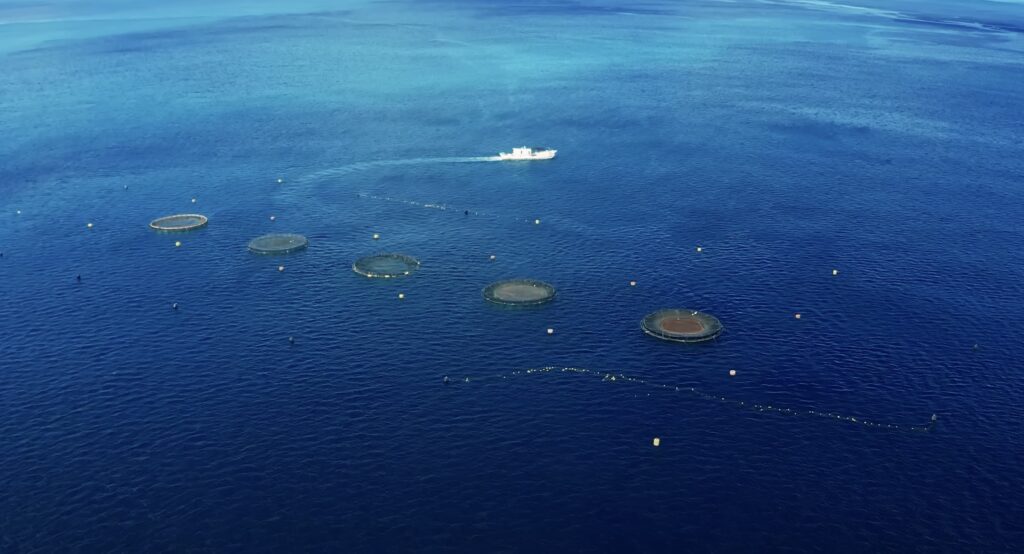
Fishnets near Checheng Beach
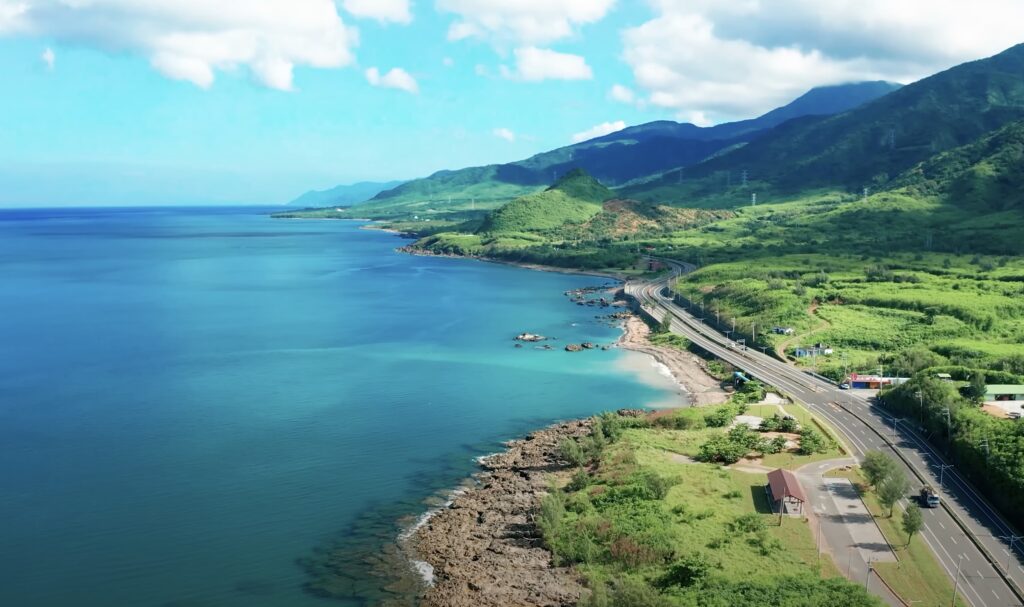
Road near Haikou Village
Sichongxi hot springs
